
The executive experts of Investment & Business Services Hungary contributed their perspective to an analysis on the current challenges and opportunities of the investment environment and investment incentives in Hungary, published in the BBJ Investing in Hungary magazine.
In recent years, Hungary has set records in attracting foreign direct investment (FDI), particularly in the automotive and electronics sectors. However, the environment has now fundamentally changed: geopolitical uncertainty, declining European demand, and increasing regional competition are shaping the new realities.
As investment advisors, we deal with these challenges on a daily basis. In the article, we shared what we consider critical for Hungary to remain competitive: from developing a skilled workforce to targeted incentives and ensuring appropriate industrial infrastructure.
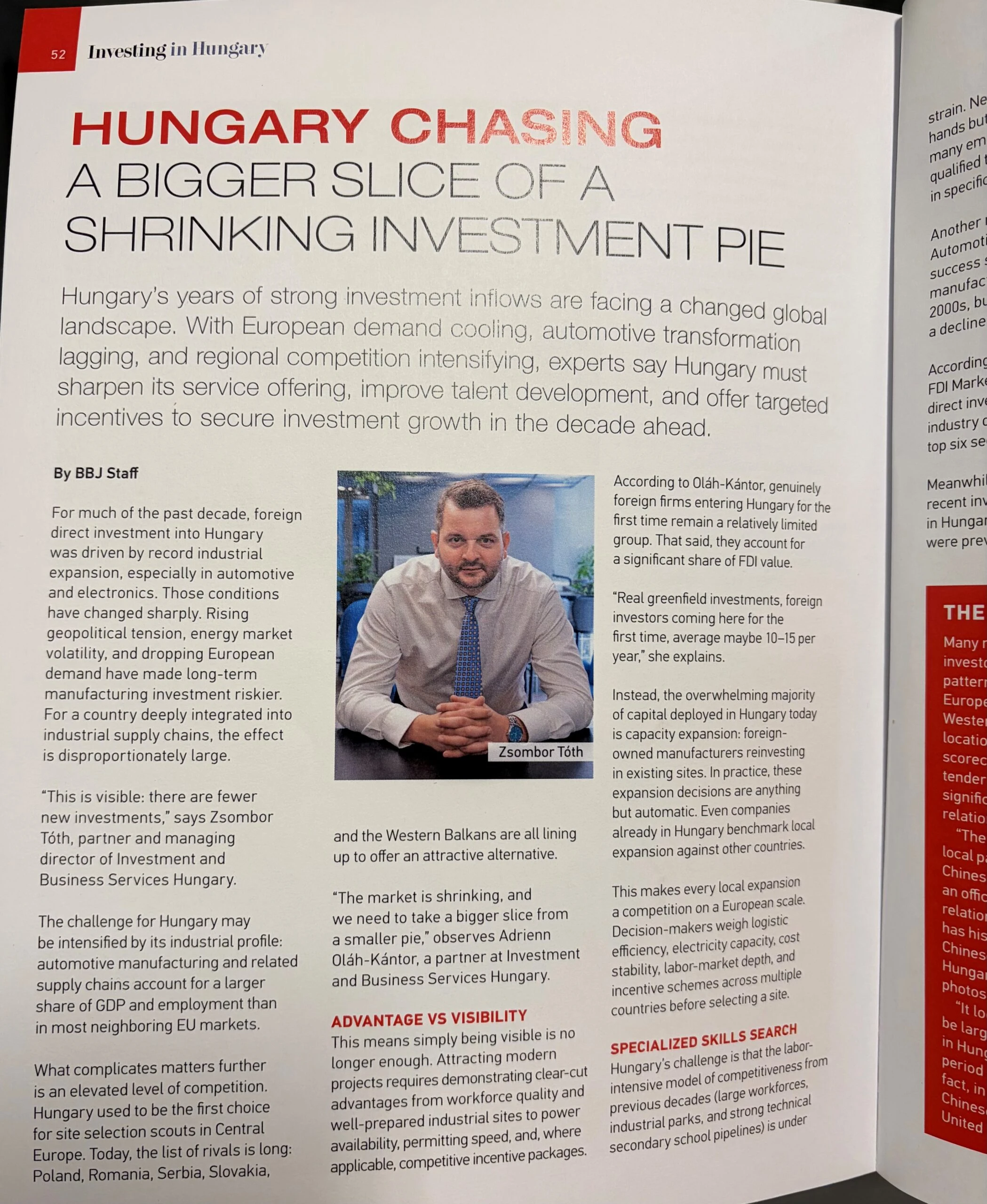
Below is an excerpt from the article published in BBJ Investing in Hungary.
For full access to the article, we recommend purchasing the publication.

Hungary Aims for a Larger Slice of a Shrinking FDI Pie
For many years, Hungary experienced strong foreign direct investment inflows, but the global environment has changed. Alongside cooling European demand, delayed transformations in the automotive sector, and intensifying regional competition, investment promotion, workforce development, and access to targeted incentives have become critical. Hungary can maintain investment growth and continuity in the coming decade through these measures.
In much of the past decade, Hungary’s FDI inflows were driven by record industrial growth—especially in the automotive and electronics sectors. These conditions have now shifted significantly. Increasing geopolitical tensions, volatility in energy markets, and declining European demand have made long-term industrial investments riskier. For a country deeply embedded in industrial supply chains, this has a disproportionately large impact.
“This trend is visible: fewer new investments are being made,” says Tóth Zsombor, Partner and CEO at Investment & Business Services Hungary.
Hungary’s industrial profile further complicates the situation: automotive production and related supply chains contribute more to GDP and employment compared to neighboring EU countries.
The situation is made more challenging by rising competition. Previously, Hungary was the top choice for Central European site selection. Today, competitors such as Poland, Romania, Serbia, Slovakia, and the Western Balkans all appear as attractive alternatives.
“The market is shrinking, and we need to carve a bigger slice from a smaller pie,” says Oláh-Kántor Adrienn, Partner at Investment & Business Services Hungary.

Competitive Advantage or Mere Presence?
It is no longer enough just to “be visible.” Attracting modern investments requires clear competitive advantages: from a skilled workforce and prepared industrial sites to reliable energy supply, fast permitting, and competitive incentive packages.
According to Oláh-Kántor, companies entering the Hungarian market for the first time still represent a relatively small group—but these greenfield investments make up a significant portion of FDI value.
“Annually, there are roughly 10–15 genuine greenfield investments, meaning when a foreign company enters Hungary for the first time,” she explains.
In contrast, the majority of invested capital today goes to capacity expansion: foreign companies already operating in Hungary invest in existing sites. However, these decisions are far from automatic. Even companies already present in Hungary compare local expansion opportunities with other countries.
Therefore, every expansion decision creates a competitive situation—at a European level. Decision-makers compare multiple countries based on logistics efficiency, energy supply, cost stability, labor market depth, and incentive systems to select the final location.